In Category on 19 Oct 2026
How Greece built its national data portal on CKAN
data.gov.gr now holds 22,000+ datasets from 510+ public bodies, with DCAT-AP metadata, quality scores and harvesting into data.europa.eu
CKAN 2.12 is the most significant release in years. The code is ready — what it ships as depends on how many people test it, translate it, and review the docs over the coming weeks.
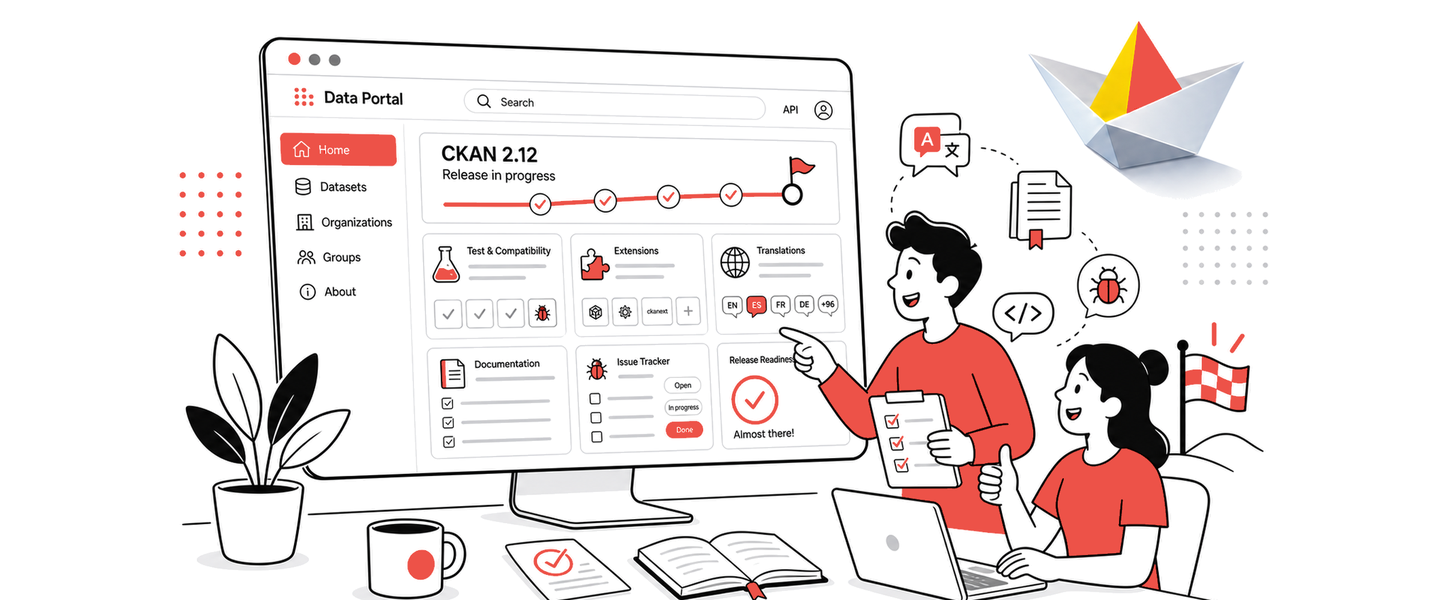
CKAN 2.12 is the most significant release in years. Faster large dataset downloads — up to 15× in some configurations. A meaningfully leaner, more secure Docker base. A stack of long-standing issues finally resolved. If you've been running a CKAN portal and quietly absorbing its rough edges, this release is for you.
We've formally opened the release process. The code is ready to be tested, translated, and documented — and the quality of this release depends directly on how many people do that work over the coming weeks. Here's how.
The only way to know whether 2.12 works reliably across the full range of portal configurations, extensions, and deployment environments is to actually run it. We can't do that alone.
Extension compatibility tracking. The most valuable thing right now is knowing which extensions work with 2.12 and which don't. We're maintaining a live tracking issue on GitHub. Check whether your extension is listed, run the test, and report back. If you maintain a community extension, apply the same process to your own codebase.
Deploy the dev branch. The dev-v2.12 branch is what becomes the release. Deploy it in a staging environment and test it against your actual portal stack. Real-world configurations find things that CI never does.
Test the new Docker images. We've made meaningful changes to the 2.12 base images — smaller footprint, better security posture, and upgraded to Python 3.14. Test them with the tags ckan/ckan-base:2.12b and ckan/ckan-dev:2.12b and report anything unexpected as a GitHub issue.
Every test report is a direct contribution to every portal that runs on 2.12 after launch.

CKAN runs data portals on six continents. When a portal officer in Nairobi, Bogotá, or Tallinn opens CKAN for the first time, they should find it in their language. Translations are one of the highest-leverage contributions you can make — a single afternoon of work extends CKAN's reach to an entire language community.
We manage translations through Transifex. Register for a free account, request to join a language team, and make sure you select the CKAN 2.12 resource once you're in. Whether you're filling gaps in an existing translation or starting a new one, every string you translate counts.
A single afternoon of work extends CKAN's reach to an entire language community.
Documentation is the first thing a new CKAN deployer reads and the last thing contributors tend to update. The result is that gaps accumulate, instructions go stale, and new features land without explanation. Fresh eyes catch what familiarity misses — and a single clear fix to the installation docs saves dozens of people hours of confusion downstream.
These sections need the most attention right now:
If you're comfortable with pull requests, submit your changes directly to the main CKAN repository. If not, open an issue describing what you found. Both are genuinely useful.
The window to shape what 2.12 ships as is open right now. We're building this together.

CKAN 2.12 is not going to ship itself into the quality it deserves. The release is only as robust as the range of environments it's been tested in, the languages it speaks, and the clarity of the documentation that guides people through it.
There are hundreds of CKAN deployments out there serving governments, research institutions, and humanitarian organisations. The people maintaining those portals benefit directly from the work you do here — that's how open source actually works. If you run into something, open an issue on GitHub. Want to discuss before diving in? Find us on Gitter / Matrix.
data.gov.gr now holds 22,000+ datasets from 510+ public bodies, with DCAT-AP metadata, quality scores and harvesting into data.europa.eu
If you run a CKAN portal, 2.12 is the release to pay attention to. Large downloads stop crawling, files become things you can manage in their own right, the interface gets a modern refresh, and older instances get critical security fixes. It's the last 2.x release — and the groundwork for everything 3.0 brings.